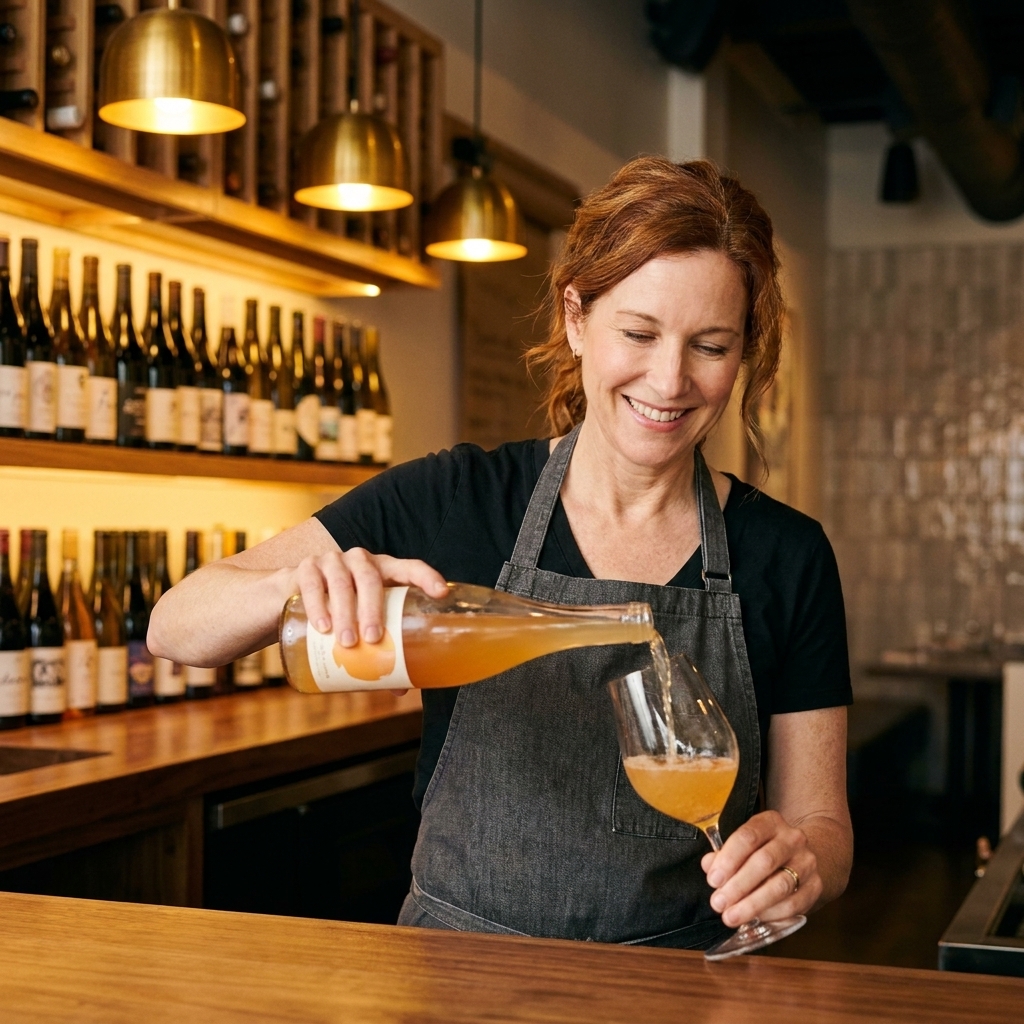
Natural wine can feel like a secret handshake. The menu says “skin-contact,” the server says “a little funky,” and suddenly you are wondering if you accidentally signed up for a geology lecture. You did not. You are just trying to order something delicious.
Think of this as your table-side cheat sheet: the terms restaurants use, the flavors you can expect, and how to ask the right questions without sounding like you are auditioning for a sommelier exam.
What “natural wine” means
There is no single global legal definition of “natural wine,” which is why it gets messy fast. In practice, most restaurants and wine bars use it to describe wines made with a low-intervention approach in both the vineyard and the cellar.
- In the vineyard: grapes grown with an emphasis on organic or biodynamic farming, avoiding most synthetic herbicides, pesticides, and fertilizers. (Standards vary by country and certifier, and many programs still allow certain approved treatments such as copper or sulfur.)
- In the cellar: fewer additives, less manipulation (less filtration, less fining), and often lower sulfur additions.
Important nuance: “Natural” is not automatically better. It is simply a style and a set of choices. The best natural wines are alive, expressive, and wildly food-friendly. The worst ones taste like a science project someone forgot in a hot car.
Menu terms you will see
Low-intervention
This is the broadest, most restaurant-friendly phrase. It signals that the producer is trying not to “correct” the wine into sameness. Expect personality. Sometimes that personality is clean and bright. Sometimes it is a little wild.
Organic
Organic refers to how grapes are farmed. Certification rules vary by country, but generally organic programs prohibit most synthetic pesticides and herbicides while allowing certain approved inputs. Organic does not automatically mean the winemaking is low-intervention, but there is often overlap.
Biodynamic
Biodynamics is a farming philosophy (and in some cases, certification) that treats the vineyard like an ecosystem. You might see producers associated with Demeter certification. In the glass, biodynamic does not guarantee a specific flavor, but biodynamic wines often show a strong sense of place and energy.
Skin-contact
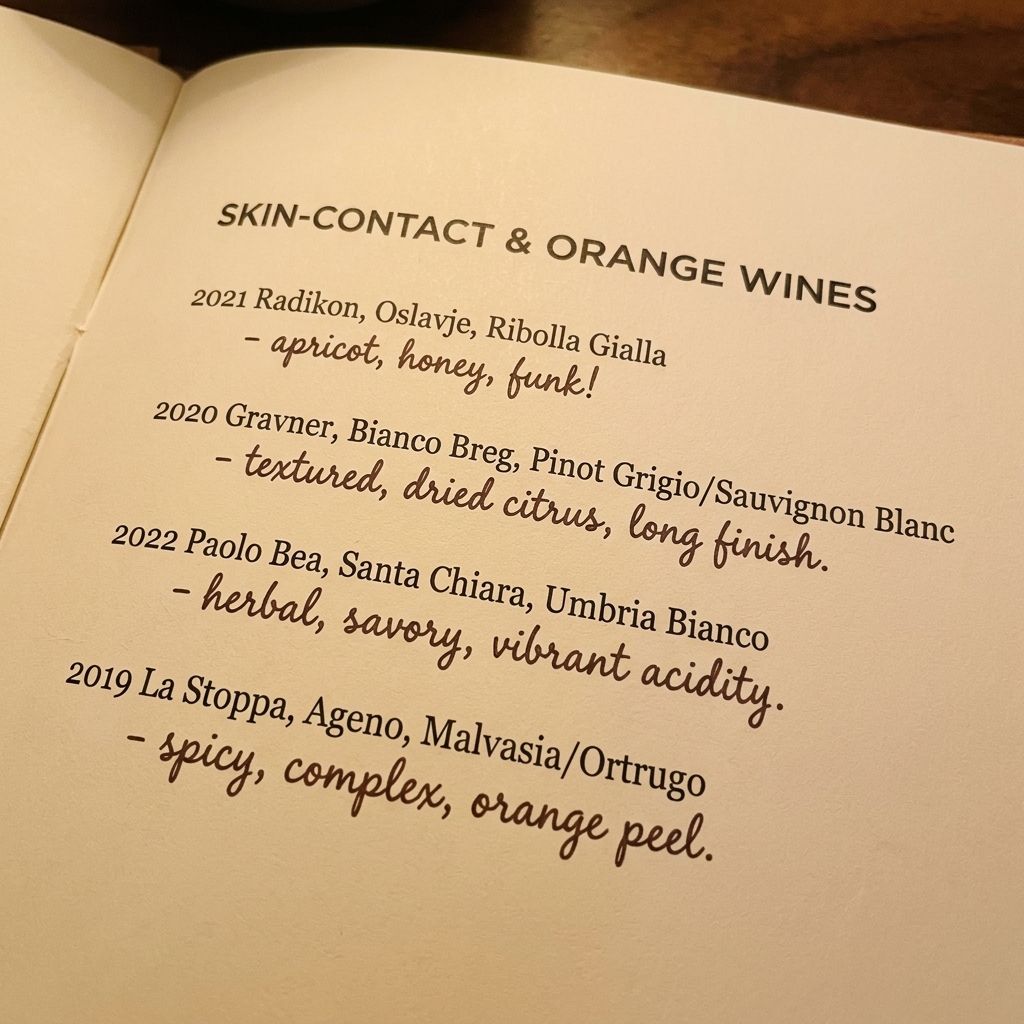
Also called orange wine (though it is not made from oranges). White grapes are fermented with their skins, like red wine. That brings color, texture, and sometimes tannin.
What it can taste like: dried apricot, orange peel, tea, chamomile, bruised apple, a gentle grippy finish.
Pet-nat
Short for pétillant naturel. Sparkling wine made with a single fermentation that finishes in the bottle, often unfiltered. It can be hazy, lightly fizzy, and very refreshing.
What it can taste like: tart apple, lemony snap, pear, yogurt-like tang (lactic), sometimes a yeasty “bready” note.
Unfiltered / unfined
Unfiltered wines can look cloudy because sediment remains. Unfined means no fining agents were used to clarify the wine. Cloudiness is not a flaw, but it is not a guarantee of quality either. It is simply part of the look and feel of many natural wines.
Native yeast / spontaneous fermentation
This means the fermentation relies on yeasts present on the grape skins and in the winery environment. Many natural producers lean on spontaneous ferments because it fits the low-intervention philosophy, but it is not a universal rule. Some “natural” winemakers use selected yeasts, and plenty of conventional producers ferment spontaneously too.
Minimal sulfur / no added sulfites
Sulfur dioxide (SO2) is used to stabilize wine. Some natural producers use none. Many use a small amount at bottling. Also worth knowing: even “no added sulfites” wines can still contain naturally occurring sulfites from fermentation.
Low-sulfur wines can be gorgeous, but they can also be more fragile, especially once opened.
How to read the list
Natural-leaning lists often organize bottles by vibe rather than by strict region. You might see sections like “Fresh,” “Textural Whites,” “Glou-Glou Reds,” or “Chillable.” Here is how to translate that into a confident order.
Start with structure
- Crisp: think citrus, high refreshment, and a stony or saline impression. Great with oysters, salads, seafood, salty snacks.
- Juicy: bright fruit, low tannin, easy-drinking reds, often meant to be chilled. Great with burgers, charcuterie, roast chicken.
- Grippy: tannin or phenolic bite (often skin-contact whites). Great with richer vegetables, mushrooms, pork, spice, and anything with crunch and fat.
Look for house cues
If the menu names importers (like Jenny & François, Zev Rovine, Selection Massale, Vom Boden, Louis Dressner), you are often in natural territory. Not every bottle from every importer is the same style, and these are not guarantees, but those names can be a helpful clue that the list is curated with low-intervention in mind.
Watch for serving notes
Natural-friendly restaurants often tell you how they want you to drink it: “serve cold,” “decant,” “slightly cloudy,” “bottle variation.” Those notes are not warnings. They are hospitality. They mean the staff has opened this wine before and has opinions.
Tasting notes, decoded
Natural wine language can sound vague because it is often describing texture and aroma more than traditional fruit-and-oak markers. Here are the big ones you will run into.
“Funky”
This is the most overworked word in the category. It can mean anything from a whiff of barnyard to a kombucha-like tang to a savory, earthy edge.
- If you like: sour beer, kombucha, washed-rind cheese, fermented foods.
- If you do not like: ask for “clean” natural wines, or “low-intervention but not funky.” That phrase saves everyone time.
“Cloudy” or “hazy”
Usually unfiltered. Haze alone does not equal funk. Many hazy wines are bright and pure.
“Volatile” or “VA”
Volatile acidity can smell a bit like nail polish remover or balsamic. In small amounts, some people find it adds lift. In large amounts, it dominates. If you are sensitive to sharp vinegar aromas, steer away.
“Mousey”
This is a real off-flavor some low-sulfur wines can show, often appearing after you swallow, like a weird cracker or rodent-cage finish. If a staff member mentions it, they are being honest. Choose something else.
“Glou-glou”
French slang for gulpable. Usually light-bodied, juicy, low tannin, and dangerously easy to drink. Often served with a chill.
Style or fault?
A little farmy aroma, a touch of haze, or a savory edge can be stylistic. Excessive VA (all vinegar, no fruit), obvious oxidation (flat, bruised-apple-sherry when it is not supposed to), or mousiness are usually faults. If your glass tastes off, it is okay to say so. Good restaurants would rather swap it than watch you suffer politely.
What to order first
If you are new, you do not need to start with the most challenging bottle on the list. Start with styles that tend to be both natural-friendly and broadly crowd-pleasing.
1) Chillable reds
Look for Gamay, Frappato, Cinsault, Pineau d’Aunis, Schiava (Vernatsch), Trollinger, lighter Blaufränkisch, or Pinot Noir from cooler-leaning regions. You will often see “serve chilled” next to these.
2) Bright, salty whites
Muscadet, Vermentino, Txakolina, some Grüner Veltliner, and many Loire whites can be a clean gateway into low-intervention.
3) Pet-nat
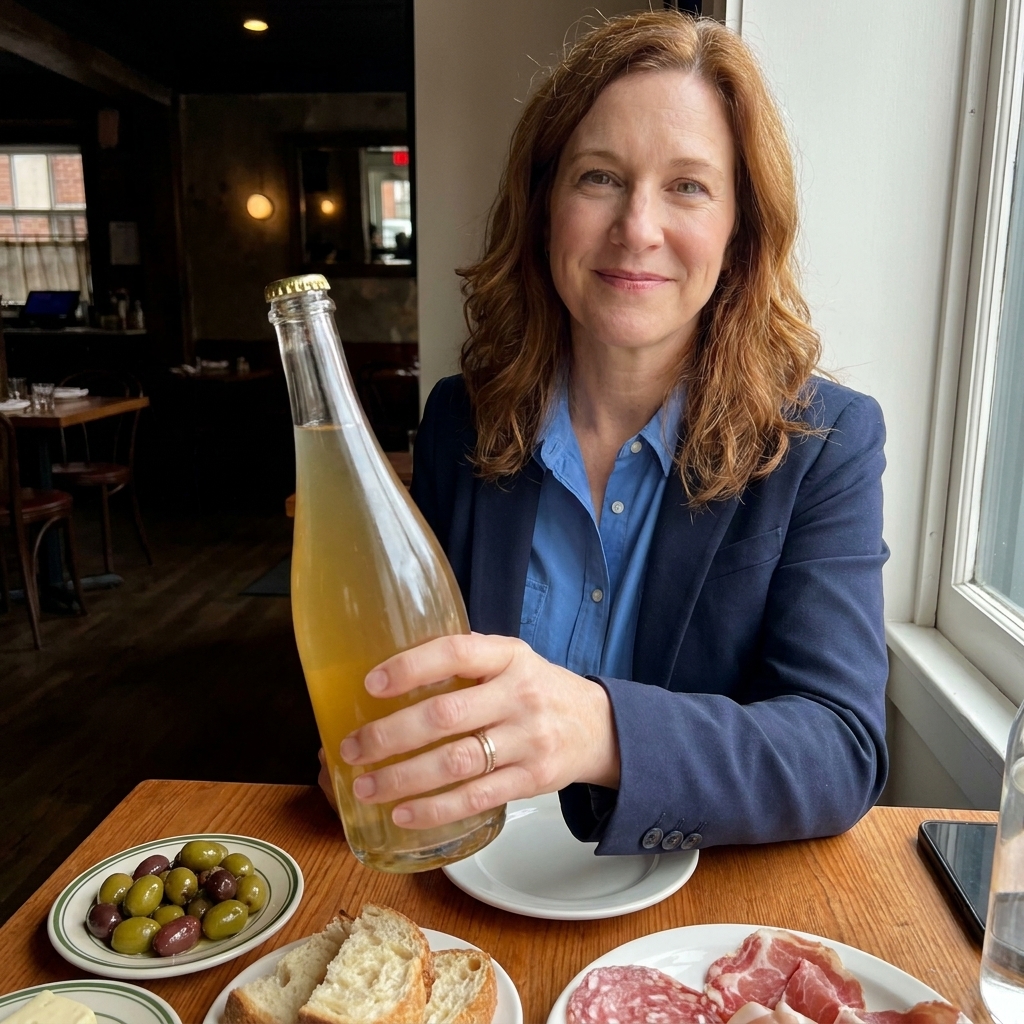
Pet-nat is the friend who shows up with snacks and makes the night feel fun. Just know it can be slightly unpredictable. That is part of the charm.
4) Skin-contact, start light
If you want orange wine, ask for something “more citrusy than tannic” or “more fresh than funky.” Servers understand those guardrails.
How to order like a regular
You do not need perfect terminology. You need a clear preference and one honest sentence about your comfort zone.
Three scripts
- “I want something natural-leaning but clean. More fresh than funky.”
- “I usually like Sauvignon Blanc. What is your closest low-intervention option?”
- “I am eating the fried chicken. What natural wine pairs best with salty and crispy?”
Ask for a taste
In most restaurants with natural wine programs, a small taste is normal, especially by-the-glass. If the wine is doing something odd, the staff wants to know. Good programs are proud, not precious.
Know the temperature
Many natural reds are served cooler than you might expect because it keeps them bright and juicy. Skin-contact wines are often served like whites, cool but not ice-cold, so you can actually taste the texture. If your glass feels warmer or colder than you like, ask. That is a normal request.
If you are worried about “getting it wrong,” remember this: wine is not a personality test. It is a beverage. Order what makes dinner better.
What restaurants juggle
Natural wines can be more delicate because many have less sulfur and less filtration. That affects how restaurants store, open, and serve them.
- Storage matters: heat and light are the enemy. Serious spots keep bottles at proper temps.
- By-the-glass takes discipline: opened bottles are kept cold and tightly sealed, rotated quickly, and sometimes protected with inert gas or preservation systems.
- Bottle variation is real: the same wine can show slightly differently across bottles. It is not always a problem, but it is part of low-intervention reality.
When a server gently nudges you toward a different bottle, it is often because they know which one is singing tonight.
Food pairing wins
Natural wine shines at the table because acidity and texture play nicely with food. A few reliable matchups:
- Fried foods: pet-nat, Champagne-method sparklers, or high-acid whites.
- Spicy dishes: chillable reds, lightly off-dry whites, or aromatic skin-contact wines with some grip.
- Vegetable-forward plates: skin-contact whites, Jura-style whites, or herbal Loire reds.
- Charcuterie and snacks: glou-glou reds, Beaujolais, sparkling rosé.
Price, briefly
If a natural bottle costs more than you expected, it is often because of labor-intensive farming, small production, and the realities of importing and distribution for tiny growers. The good news is that a lot of value on natural lists shows up in the mid-range, especially in lighter reds and bright whites.
If you are dining with allergies or dietary restrictions, tell your server early. A thoughtful pairing is easier when the team understands the guardrails. Speaking as someone who learned gluten intolerance the hard way, the best hospitality is proactive, not performative.
Quick FAQ
Is natural wine always cloudy?
No. Many natural wines are crystal clear. Cloudiness usually points to unfiltered wine, not automatically “natural.”
Will natural wine give me a worse hangover?
There is no universal rule. Hangovers are driven by alcohol, sleep, hydration, and how much you drank. Some people feel better with lower-sulfur wines, but it is not guaranteed. Your best move is still water, food, and pacing.
Is biodynamic the same as organic?
They overlap, but biodynamic is a broader system with specific practices and, sometimes, certification. Organic is primarily about avoiding most synthetic inputs under a given standard.
What if I hate “funk”?
Say that. Ask for low-intervention wines that are clean, bright, and classic-leaning. There are plenty, and a good beverage team will be relieved you told them.
The one thing
The natural wine movement is at its best when it is about people: growers farming responsibly, cellar workers choosing restraint, and restaurant teams translating all of that into a glass that makes you feel taken care of. If you focus on what you like and communicate it clearly, the menu stops feeling like a club and starts feeling like a conversation.
And if the first bottle is not your favorite, welcome to the most human part of natural wine: you are allowed to learn out loud.